
If you are ordering custom hats for a clothing brand, company, promotional campaign, or retail collection, adding a logo seems simple—but the decoration method can make a big difference.
Embroidery, patches, and printing can create very different results in terms of appearance, durability, cost, and the amount of detail your logo can retain.
The right choice depends on more than your logo itself. You also need to consider the hat style, fabric, logo size, artwork detail, order quantity, and how the finished hats will be used.
This guide explains the main custom hat logo options and what buyers should consider before placing an order.
Custom hats with logo can refer to several levels of customization.
For some buyers, the process simply means choosing an existing hat style and adding a company logo.
For others, customization may include:
For most B2B orders, the first decision is usually how the logo should be applied to the hat.
That is where embroidery, patches, and printing become important.

There is no single decoration method that is best for every custom hat.
A practical comparison looks like this:
| Decoration Method | Best For | Main Advantage | Main Limitation |
|---|---|---|---|
| Flat Embroidery | Text, simple logos, brand names | Classic and durable | Limited very fine details |
| 3D Puff Embroidery | Bold logos and letters | Raised, premium appearance | Not suitable for very fine artwork |
| Woven Patch | Detailed logos and small text | Excellent detail | Different look from direct embroidery |
| Embroidered Patch | Vintage or textured designs | Strong visual impact | Adds another layer to the hat |
| PVC/Rubber Patch | Outdoor, streetwear, modern brands | Durable and dimensional | Higher tooling requirements |
| Leather/Synthetic Leather Patch | Outdoor and lifestyle brands | Premium, natural appearance | Best for simpler artwork |
| Printing | Colorful graphics and larger artwork | Good for colors and gradients | Durability depends on method and material |
The key is to match the logo + hat + application method, rather than choosing a decoration method first.
Recent industry buyer guides make the same point: artwork detail, placement, hat material, and final size all influence which decoration method works best.
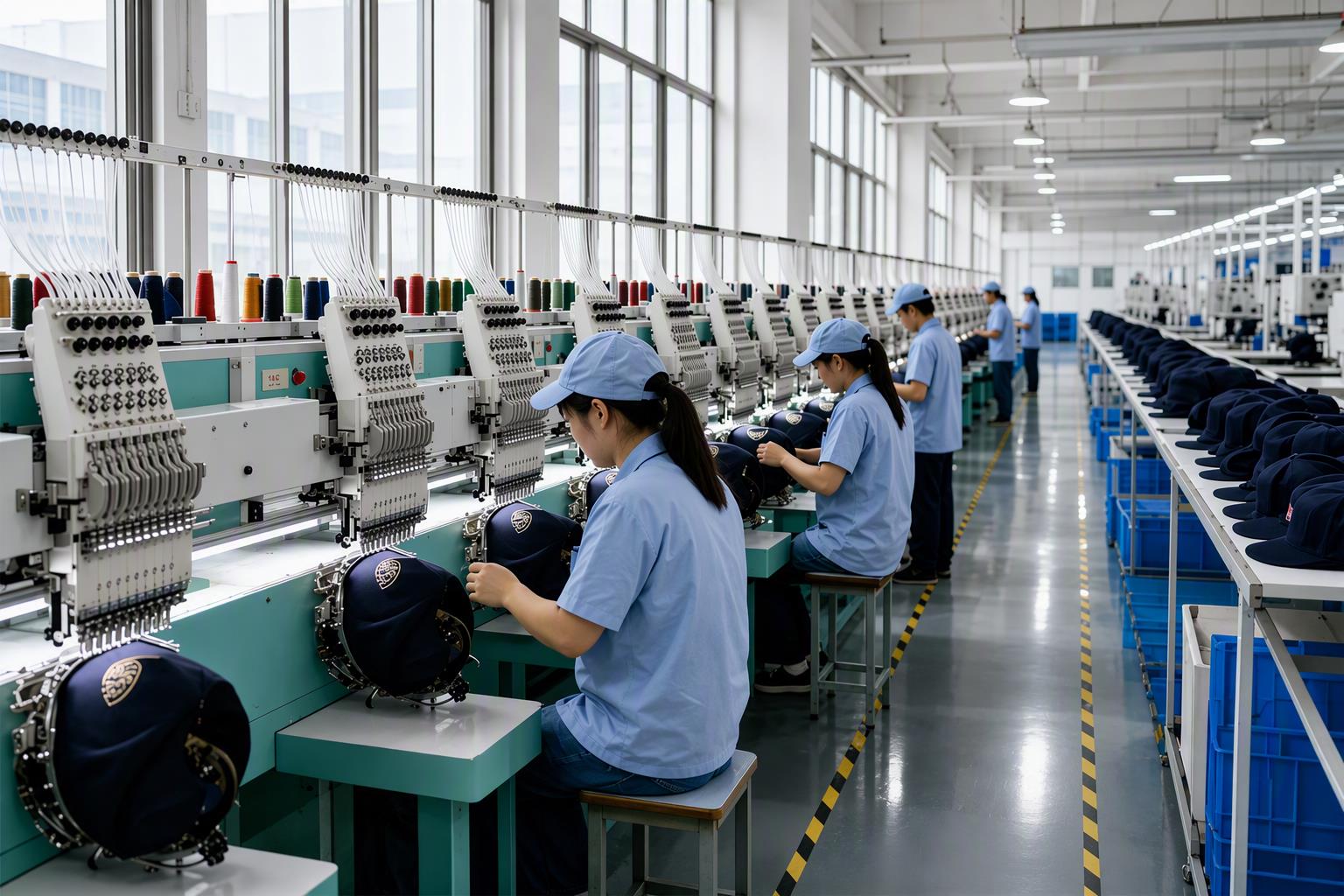
Embroidery is one of the most common choices for custom logo hats, particularly for brands, corporate apparel, sports teams, and promotional products.
The logo is stitched directly onto the hat using thread.
Flat embroidery creates a clean, traditional appearance.
It is usually a good choice when your logo contains relatively simple shapes and clear lettering.
3D puff embroidery uses a foam layer underneath the stitches to create a raised effect.
It can work particularly well for:
However, 3D embroidery is not automatically better than flat embroidery. Small text and complicated artwork may lose clarity when converted to a raised design.
A good manufacturer should review your artwork before production rather than simply accepting the original file without adjustment.
Patches have become an important option for custom logo hats, especially for lifestyle, outdoor, workwear, streetwear, and fashion brands.
Instead of stitching the logo directly onto the hat, the logo is produced as a separate patch and then attached to the front panel.
Common options include:
A patch can give your hat a different visual identity from traditional embroidery.
For example:
Woven patches can work well when your artwork contains relatively fine details or small lettering.
Leather or synthetic leather patches can create a premium outdoor or lifestyle appearance.
PVC or rubber patches can provide a modern, dimensional look and are particularly useful for designs that benefit from a clean molded shape.
The important point is that patch materials and construction should be selected according to the artwork and intended use—not simply because a certain patch style is popular.
Printing is another option for custom hats with logo, particularly when the design contains multiple colors, gradients, illustrations, or larger graphic elements.
Depending on the hat material and production method, printing may include different techniques.
Printing can be useful when your artwork contains:
However, printing needs to be evaluated against the actual hat fabric and construction.
A printing method that works well on a flat surface may not perform the same way on a curved or textured hat panel.
Therefore, buyers should ask the manufacturer to confirm:
Instead of asking:
“Which logo method is the best?”
Ask:
“Which logo method is best for my artwork and my hat?”
Here is a simple decision guide.
The right decoration method ultimately depends on the combination of artwork, hat material, placement, quantity, budget, and intended use.
Yes, sometimes.
This is an important issue that buyers often overlook.
A logo designed for a website or business card is not necessarily ready to be embroidered or converted into a patch.
For example, your original logo may contain:
When the same logo is reduced to a 2–3 inch decoration on a curved hat panel, some details may become difficult to reproduce.
For embroidery, the artwork normally needs to be digitized so the embroidery machine knows how to interpret the design.
A professional manufacturer should tell you when an adjustment is necessary instead of producing an inaccurate version of your logo.
The front panel is the most common logo location, but it is not the only option.
Best for:
Good for:
Often used for:
Can be used for more creative branding details.
The available decoration area depends on the hat construction. Seams, mesh panels, curved surfaces, and material thickness can all affect the final result.
That is why the manufacturer should confirm the maximum decoration size and placement before production.
There is no single price for custom hats with logo.
The final cost can be affected by:
For example, a simple embroidered logo on one front panel is very different from a custom hat with a large embroidered logo, side embroidery, a leather patch, custom labels, and retail packaging.
For B2B buyers, it is better to compare complete specifications and total production cost rather than comparing only the unit price.
If the logo is important to your brand, a sample should be part of the purchasing process.
A physical sample allows you to check:
For more complicated artwork, it can also be useful to compare two or more decoration methods before making the final decision.
For example:
Same Logo → Embroidery Sample → Patch Sample → Printing Sample → Compare → Approve → Bulk Production
This is much safer than choosing a method based only on a digital mockup.
Current buyer-focused industry guidance also emphasizes approving the decorated physical sample and checking the finished dimensions and placement before production.
To receive a more accurate quotation, prepare as much information as possible.
Ideally, send:
1. Logo or artwork
Preferably an editable vector file such as AI, EPS, or PDF when available.
2. Hat style
For example:
3. Decoration method
If you are unsure, simply tell the manufacturer what look you want and ask for a recommendation.
4. Logo size
If you know the required dimensions, include them.
5. Logo position
Front, side, back, brim, etc.
6. Quantity
Quantity can significantly affect production cost.
7. Hat color and material
Include reference colors if available.
8. Packaging requirements
Especially important for retail brands.
A professional manufacturer should be able to review these specifications and tell you if the proposed logo method is technically suitable.
Before placing your order, make sure you have confirmed:
☐ Hat style
☐ Hat material
☐ Hat color
☐ Logo artwork
☐ Logo size
☐ Logo placement
☐ Decoration method
☐ Thread/print colors
☐ Patch material, if applicable
☐ Sample approval
☐ Quantity
☐ Packaging
☐ Production lead time
☐ Quality requirements
If your logo is complicated, do not choose embroidery, patches, or printing based only on price.
Ask the manufacturer to explain which method will reproduce your design most accurately.

For international buyers, choosing the decoration method is only one part of the sourcing process.
An experienced custom hat manufacturer should be able to help you evaluate the relationship between your artwork, hat construction, decoration method, production requirements, and final cost.
At HXMCaps, buyers can provide a logo, reference image, or existing hat design and discuss the appropriate customization method before moving into sample production.
Whether you need custom embroidered hats, custom patch hats, printed caps, private label hats, or OEM/ODM headwear, the goal should be the same: turn your artwork into a finished product that matches your brand requirements.
Have a logo or hat design in mind?
Send us your logo, hat style, quantity, and customization requirements. We can help you evaluate the appropriate decoration method and move from artwork to sample and, finally, bulk production.
Request a custom hat sample today.
There is no universal best method. Embroidery works well for simple and bold logos, patches can provide more texture and different visual effects, while printing can be useful for colorful or highly graphic artwork.
Not necessarily. Embroidery generally provides a classic stitched appearance, while printing can reproduce certain colorful or detailed graphics more effectively. The best option depends on the artwork and hat material.
Woven, embroidered, leather, synthetic leather, PVC, and rubber patches each create different results. The best option depends on your logo, desired appearance, hat material, and budget.
Most common hat styles can be customized, but the decoration area and suitable method depend on the hat construction and material. A manufacturer should confirm compatibility before production.
Yes. A physical sample lets you check the hat, logo size, placement, colors, embroidery or patch quality, and overall workmanship before committing to a bulk order.