
Choosing the right custom hat manufacturer is about much more than comparing prices. Certifications help buyers verify quality, compliance, and reliability before placing an order.
Finding the right custom hat manufacturer can be challenging, especially when hundreds of suppliers appear to offer similar products, competitive prices, and fast lead times. Many factories promise premium quality, sustainable materials, and strict quality control, but not every supplier can provide independent proof of these claims.
For importers, distributors, promotional product companies, fashion brands, and retailers, choosing the wrong manufacturing partner can result in delayed shipments, inconsistent product quality, compliance issues, or even product recalls. These risks can damage your business reputation and increase long-term sourcing costs.
This is why experienced buyers rarely rely on marketing materials alone. Instead, they evaluate whether a manufacturer has obtained internationally recognized certifications issued by independent organizations. These certifications demonstrate that a factory follows established standards for quality management, social responsibility, environmental protection, and product safety.
However, certifications should not simply be accepted at face value. Some suppliers display expired certificates, use certificates that belong to another company, or promote certifications that do not even apply to the products they manufacture. Knowing which certifications truly matter—and how to verify them—is an essential part of selecting a reliable supplier.
In this guide, you'll learn:
Whether you're sourcing custom baseball caps, trucker hats, beanies, bucket hats, or private label headwear, this guide will help you make a more informed purchasing decision and reduce sourcing risks.
When buyers compare suppliers, price is often the first factor they consider. While competitive pricing is important, it should never be the only criterion. A slightly lower unit cost can quickly become far more expensive if the products fail quality inspections, shipments arrive late, or compliance issues lead to rejected orders.
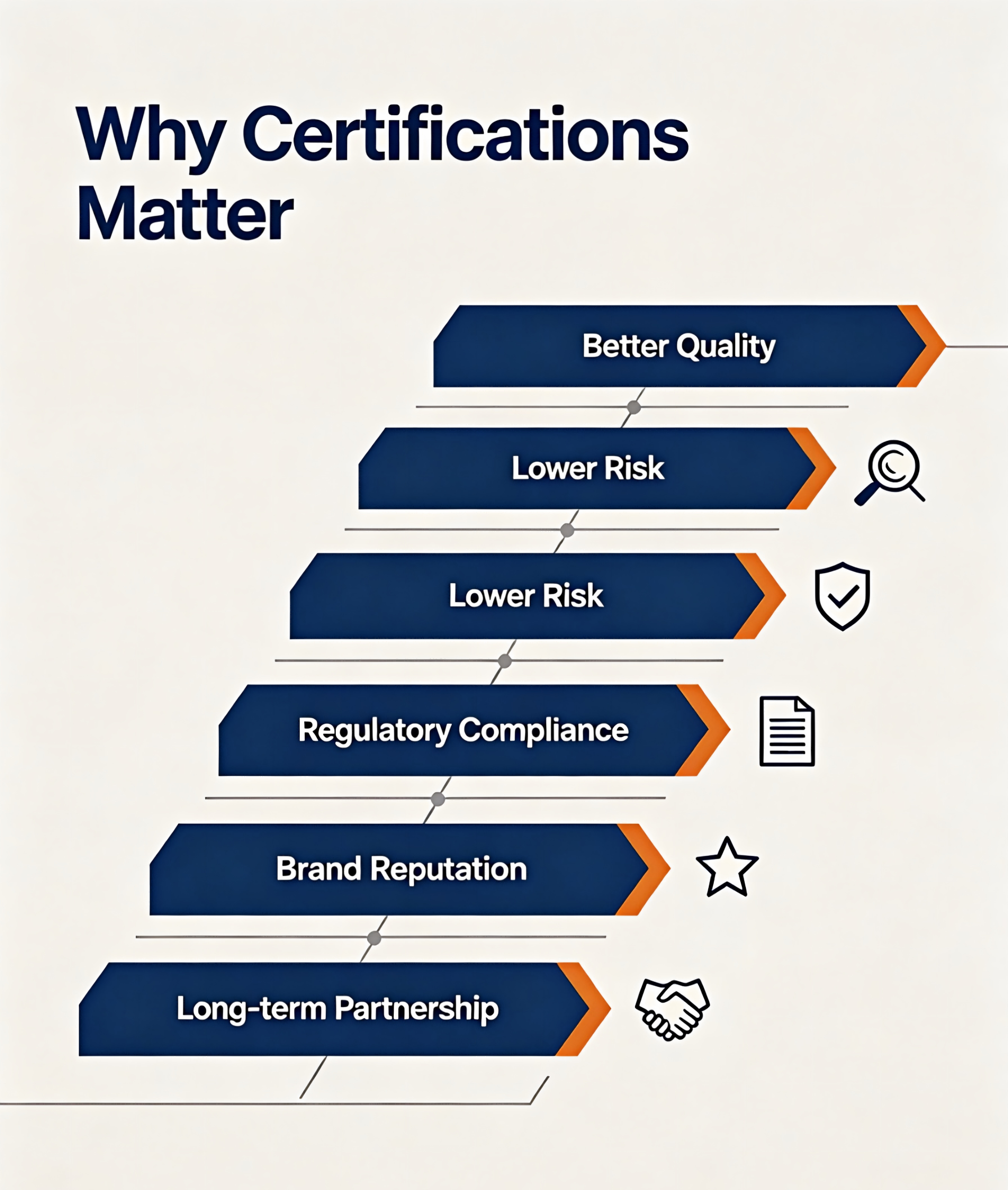
Professional buyers understand that certifications provide an objective way to evaluate a manufacturer's capabilities before placing large production orders.
Every manufacturer can claim to have excellent quality, experienced workers, or sustainable production practices. Certifications offer third-party verification that these claims have been assessed against internationally recognized standards.
Instead of relying solely on sales presentations, buyers can use certifications to determine whether a supplier has implemented documented management systems, quality control procedures, and standardized production processes.
This significantly reduces uncertainty during supplier selection.
Manufacturing problems rarely occur because of one major mistake. More often, they result from weak production management, inconsistent quality control, poor documentation, or inadequate employee training.
Certified manufacturers are generally required to maintain structured operating procedures, conduct regular internal audits, and continuously improve their management systems.
Working with certified suppliers can help reduce risks such as:
Although certifications cannot guarantee perfection, they greatly improve production consistency.
Large retailers, fashion brands, promotional product companies, and corporate buyers often require suppliers to hold specific certifications before they are approved for production.
For example:
Without these certifications, many manufacturers cannot participate in larger procurement projects or become long-term suppliers for international brands.
Purchasing custom hats is rarely a one-time transaction. Successful brands typically work with the same manufacturer over many years.
Certified manufacturers are generally better equipped to maintain consistent product quality across multiple production runs. This consistency helps buyers avoid unexpected quality variations that may occur when switching suppliers or expanding order volumes.
A stable manufacturing partner also makes it easier to develop new products, launch seasonal collections, and respond quickly to changing market demands.
Your customers judge your brand based on the products you deliver—not the factory that produced them.
If hats arrive with poor stitching, inconsistent sizing, color differences, or material defects, customers will remember your brand rather than the manufacturer.
Choosing a factory that follows internationally recognized standards helps reduce these risks and protects the reputation you've worked hard to build.
For businesses selling through Amazon, Shopify, retail stores, or corporate promotional channels, maintaining consistent product quality is essential for positive customer reviews and repeat business.
Obtaining certification is not a one-time achievement. Most internationally recognized certifications require regular surveillance audits, document reviews, and ongoing compliance.
This means certified manufacturers are expected to continuously improve their management systems, employee training, production efficiency, and quality performance.
For buyers, this provides additional confidence that the factory is investing in long-term operational excellence rather than focusing only on short-term production.
Understanding why certifications matter is only the first step. The next question is: Which certifications should you actually look for when evaluating a custom hat manufacturer?
Not every certificate carries the same weight, and not every supplier needs every certification. In the next section, we'll break down the 12 most important certifications that buyers should verify, explain what each one means, why it matters, and how you can confirm it's genuine before placing an order.
Not every certification has the same purpose. Some focus on quality management, while others evaluate environmental responsibility, product safety, or workplace conditions.
Understanding what each certification means—and whether it is relevant to your products—can help you select a supplier that aligns with your business requirements.
ISO 9001 is one of the world's most widely recognized quality management certifications. It demonstrates that a manufacturer has established standardized processes for production, quality control, documentation, corrective actions, and continuous improvement.
Rather than evaluating a single product, ISO 9001 assesses how the factory manages its overall operations to deliver consistent quality.
For buyers sourcing custom hats, consistency is critical. Every production run should match approved samples in terms of fabric, color, stitching, logo placement, sizing, and packaging.
An ISO 9001-certified manufacturer is more likely to have:
These systems help reduce defects and improve production consistency.
ISO 9001 is valuable for almost every buyer, including:
Ask the supplier to provide:
Then confirm the certificate through the issuing certification body if necessary.
The Business Social Compliance Initiative (BSCI) evaluates whether a factory follows internationally recognized standards for ethical manufacturing and responsible labor practices.
A BSCI audit typically covers:
Consumers increasingly expect brands to source products responsibly. Retailers and international brands also face growing pressure to ensure ethical manufacturing throughout their supply chains.
Working with a BSCI-audited manufacturer helps reduce reputational and compliance risks.
BSCI is commonly requested by:
Request:
Make sure the report belongs to the factory you are working with—not another supplier.
The Global Recycled Standard (GRS) verifies that products contain certified recycled materials while meeting strict environmental and social requirements throughout the manufacturing process.
For custom hats, GRS often applies to recycled polyester fabrics, recycled cotton, and sustainable textile materials.
Sustainability has become an important purchasing factor for many brands.
Using GRS-certified materials helps companies:
Many buyers also use GRS products in their marketing campaigns.
GRS certification is especially important for:
Request:
Remember that not every product produced by a factory is automatically GRS-certified. Only approved products made with certified materials qualify.
OEKO-TEX® STANDARD 100 certifies that tested textile materials are free from harmful levels of substances that may affect human health.
Testing covers a wide range of chemicals, including substances restricted by international regulations.
Customers expect hats to be safe for everyday wear, especially products intended for:
OEKO-TEX certification provides additional confidence that fabrics have been tested for harmful substances.
Common buyers include:
Ask for:
Then verify the certificate through the official OEKO-TEX database.
Sedex is a global platform for responsible sourcing, while SMETA (Sedex Members Ethical Trade Audit) evaluates a factory's ethical business practices.
The audit typically reviews:
Many international buyers require suppliers to complete SMETA audits before cooperation.
The audit demonstrates transparency and responsible supply chain management.
Sedex is frequently requested by:
Ask whether the factory has:
Review the audit scope carefully to ensure it matches the manufacturing site.
WRAP (Worldwide Responsible Accredited Production) focuses on ethical, lawful, and safe manufacturing.
Factories seeking WRAP certification must comply with principles covering:
Many international apparel brands prefer suppliers that demonstrate responsible manufacturing practices beyond product quality alone.
WRAP certification indicates that the factory has implemented systems to support ethical production and responsible business operations.
WRAP is often requested by:
Buyers should request:
Always confirm that the certification belongs to the actual production facility, not a trading company or affiliated factory.
Not every buyer needs every certification. The certifications you should prioritize depend on your products, target market, and customer requirements.
As a general guideline:
| Buyer Type | Certifications to Prioritize |
|---|---|
| Fashion Brands | ISO 9001, BSCI, GRS, OEKO-TEX, WRAP |
| Promotional Products | ISO 9001, BSCI |
| Children's Hats | ISO 9001, OEKO-TEX, CPSIA |
| European Buyers | ISO 9001, BSCI, GRS, OEKO-TEX, REACH |
| Sustainable Brands | GRS, ISO 14001, OEKO-TEX |
In the next section, we'll explore six additional certifications that are equally important for specific markets, including ISO 14001, REACH, CPSIA, FSC®, GOTS, and CE, and explain when they matter—and when they don't.
While the certifications covered above are commonly requested by global buyers, there are additional certifications that become essential depending on your target market, product materials, or customer requirements.
Understanding when these certifications apply can help you avoid unnecessary costs while ensuring compliance with local regulations.
ISO 14001 is an internationally recognized certification for environmental management. It confirms that a manufacturer has established systems to monitor, control, and continuously improve its environmental performance.
Rather than focusing on the finished product, ISO 14001 evaluates how a factory manages its environmental responsibilities throughout daily operations.
These areas typically include:
Environmental responsibility has become an important factor in supplier selection, especially for brands that publish ESG (Environmental, Social, and Governance) reports or sustainability commitments.
Working with an ISO 14001-certified manufacturer can help buyers:
ISO 14001 is often requested by:
Request:
Confirm that the certificate belongs to the factory where your products will actually be manufactured.
REACH is a European Union regulation that restricts the use of hazardous chemicals in products sold within the EU market.
Although REACH is not a factory certification, many buyers mistakenly treat it as one. In reality, compliance is demonstrated through testing and documentation showing that restricted substances are within legal limits.
For custom hats, REACH may apply to:
If products fail REACH requirements, they may be refused entry into the European market, resulting in additional costs, delays, or product recalls.
Compliance helps protect both consumers and brand reputation.
REACH compliance is important for:
Ask suppliers for:
Ensure that testing applies to the actual materials used in your order.
The Consumer Product Safety Improvement Act (CPSIA) establishes safety requirements for children's products sold in the United States.
Like REACH, CPSIA is not a factory certification. Compliance is demonstrated through product testing conducted by accredited laboratories.
Testing may include:
If you're manufacturing hats intended for children under 12, CPSIA compliance is often essential for entering the U.S. market.
Non-compliant products can lead to recalls, fines, or restrictions on sale.
Request:
Always confirm that the reports correspond to the same product and materials you intend to purchase.
The Forest Stewardship Council (FSC®) certification verifies that paper and wood-based materials come from responsibly managed forests.
For custom hat manufacturers, FSC certification usually applies to:
It does not certify the hats themselves unless they contain wood or paper-based components.
Many brands are reducing the environmental impact of their packaging as part of broader sustainability initiatives.
FSC-certified packaging demonstrates responsible sourcing and supports eco-friendly branding.
Request:
If the packaging is outsourced, verify that the packaging supplier—not just the hat factory—holds valid FSC certification.
GOTS is the leading international standard for organic textiles.
Products carrying GOTS certification must contain certified organic fibers while meeting strict environmental and social criteria throughout processing.
For custom hats, GOTS is most relevant when producing hats made from organic cotton.
Demand for organic products continues to grow, particularly among environmentally conscious consumers.
Using GOTS-certified materials allows brands to communicate verified sustainability claims rather than relying on general marketing language.
Ask suppliers for:
Remember that only products manufactured under certified conditions may be marketed as GOTS-certified.
Many buyers assume every product exported to Europe requires CE marking. This is a common misunderstanding.
The CE mark applies only to products covered by specific European directives, such as electrical equipment, machinery, toys, and certain types of personal protective equipment (PPE).
Standard fashion hats, baseball caps, bucket hats, and beanies do not normally require CE marking.
However, specialized protective headwear or products with electronic components may fall within CE regulations.
Understanding whether CE marking applies helps buyers avoid unnecessary costs and misleading supplier claims.
If a supplier advertises CE certification for ordinary fashion hats without explanation, buyers should ask for clarification.
CE marking may apply to:
It generally does not apply to everyday custom hats.
If CE marking is claimed, request:
Always confirm that the CE mark is appropriate for the specific product being manufactured.
| Certification | Purpose |
|---|---|
| ISO 9001 | Quality Management |
| BSCI | Social Compliance |
| GRS | Sustainability / Recycled Materials |
| OEKO-TEX | Textile Safety |
| Sedex | Ethical Trade Audit |
| WRAP | Responsible Manufacturing |
| ISO 14001 | Environmental Management |
| REACH | Chemical Compliance |
| CPSIA | Children's Product Safety |
| FSC | Sustainable Packaging |
| GOTS | Organic Textile Standard |
| CE* | PPE Only (Not Regular Hats) |
One mistake many buyers make is assuming that a manufacturer should hold every certification listed above.
In reality, the right certifications depend on your product, target market, and customer requirements.
For example:
Instead of asking whether a factory has "all the certifications," experienced buyers focus on whether the supplier can provide the certifications that are relevant to their project.
Having a certificate listed on a supplier's website doesn't always mean it's valid. Some certificates may be expired, borrowed from another company, or simply unrelated to the products being manufactured.
In the next section, we'll show you how to verify supplier certifications, identify common warning signs, and avoid the most frequent certification scams encountered in international sourcing.
A professional supplier should never hesitate to provide proof of its certifications. If a manufacturer refuses to share certification details or avoids answering verification questions, it should be treated as a warning sign.
Fortunately, verifying a supplier's certifications is easier than many buyers think. By following a few simple steps, you can significantly reduce sourcing risks before placing a bulk order.
Many suppliers only display certification logos on their website without providing any supporting documents.
A certification logo alone does not prove that a factory is certified.
Instead, ask for a complete copy of the certificate, which should include:
A legitimate manufacturer should be able to provide these documents promptly.
One of the most common sourcing mistakes is assuming that the company name on the certificate matches the supplier you're communicating with.
In reality, some trading companies use certificates that belong to another factory.
Before placing an order, compare:
All key information should be consistent.
If the names are different, ask for a clear explanation of the relationship between the trading company and the manufacturing facility.
Many certifications are valid for a limited period and require regular audits or renewal.
Some suppliers continue displaying certificates that expired years ago.
Always check:
An expired certificate provides little assurance that the factory currently meets the required standards.
Even if a certificate is genuine, it may not cover the products you intend to purchase.
For example, a factory might hold certification for garment manufacturing but not for hats or accessories.
Similarly, a GRS certification may apply only to specific recycled materials rather than every product the factory produces.
Ask suppliers to confirm that the certification covers:
This helps avoid misunderstandings during production.
Many internationally recognized certification organizations provide online databases where buyers can verify certificate validity.
If you're placing a large order, it's worth checking directly with the issuing organization or asking the supplier to provide verification information.
A trustworthy manufacturer should have no objection to this process.
Depending on your project, certifications alone may not be enough.
For example:
Supporting documents help confirm that compliance applies to the products you are actually purchasing.
Some social compliance audits are conducted annually.
If the latest audit was completed several years ago, ask whether the factory has passed a more recent inspection.
Responsible manufacturers usually maintain up-to-date audit records and can explain their current compliance status.
Unfortunately, not every supplier is transparent about its certifications. Some use misleading information to appear more qualified than they really are.
Being aware of these common practices can help you avoid costly mistakes.
Some websites show logos such as ISO, BSCI, or GRS on every page, but the factory has never obtained those certifications.
A logo is not proof.
Always ask for the official certificate before making any purchasing decision.
A certificate that expired years ago may still appear on a supplier's website or in marketing brochures.
Expired certifications no longer demonstrate ongoing compliance because the factory has not completed the required renewal process.
Always verify the validity period before placing an order.
This is surprisingly common.
A trading company may present certificates that belong to a partner factory or another manufacturer within the same business network.
If your products will be produced in a different facility, those certifications may not apply.
Always confirm where production will actually take place.
Not every product made in a certified factory automatically qualifies as certified.
For example:
Ask whether your specific order will be produced under the relevant certification requirements.
A supplier may respond with statements like:
"Don't worry—we have all the certifications."
or
"Our certificates are confidential."
This should raise concerns.
Professional manufacturers understand that certifications are part of the supplier evaluation process and are generally willing to share relevant documentation under appropriate business arrangements.
Experienced manufacturers understand that buyers need confidence before committing to a production order.
Rather than avoiding questions, a reliable custom hat manufacturer should be willing to:
Transparency is often one of the strongest indicators of a trustworthy long-term manufacturing partner.
Now that you know how to evaluate certifications and identify misleading claims, the next step is understanding what your supplier can actually provide.
In the final section, we'll introduce the certifications held by our factory, explain how we support different customer requirements, and show you how to request samples before placing a bulk order.
Choosing a supplier isn't about finding a factory with the longest list of certifications—it's about working with a manufacturer that can provide the certifications relevant to your products and target market.
At [Your Company Name], we believe in transparency. We only present certifications that our factory currently holds and can provide upon request.
Depending on your project requirements, we can also work with certified material suppliers and testing laboratories to help support your compliance needs.
Our current certifications include:
| Certification | Purpose |
|---|---|
| ISO 9001 | Quality Management System |
| BSCI | Social Compliance & Ethical Manufacturing |
| GRS | Recycled Materials (Applicable Products) |
| OEKO-TEX® STANDARD 100 | Textile Safety (Applicable Materials) |
Note: Certification availability depends on the specific materials and products used in your order. Our team will confirm the applicable certifications during the quotation process.
While certifications are an important part of supplier evaluation, they are only one factor in building a successful long-term partnership.
Many of our customers continue working with us because we combine certified manufacturing processes with flexible OEM and ODM services, reliable communication, and consistent product quality.
When you work with us, you can expect:
With years of experience in custom headwear production, we manufacture a wide range of products, including:
Whether you are launching a fashion brand or sourcing promotional products, our team can recommend suitable materials and production methods for your market.
Every brand has different requirements.
We support:
Our project managers work closely with customers from concept development to final production, helping ensure that every detail matches the approved design.
Quality inspection is performed throughout the manufacturing process—not only before shipment.
Our quality control procedures include:
These steps help ensure that every production batch meets customer specifications.
We have served customers across multiple international markets and understand the documentation, packaging, and quality requirements of different regions.
Whether shipping to North America, Europe, Australia, or other international markets, our team works closely with customers to support smooth production and delivery.
Even if a supplier holds all the necessary certifications, requesting a sample before mass production is still one of the smartest sourcing decisions you can make.
A physical sample allows you to evaluate details that certifications cannot guarantee, such as:
Reviewing a sample also gives both parties an opportunity to confirm specifications before bulk production begins, helping reduce misunderstandings and unnecessary costs.
For custom projects, many experienced buyers approve samples before issuing the final purchase order.
If you're looking for a reliable custom hat manufacturer, we'd be happy to discuss your project.
Our team can help you:
Whether you're ordering for a startup clothing brand, an established retailer, a promotional campaign, or a corporate event, we're committed to providing transparent communication and consistent manufacturing quality.
Contact us today to discuss your requirements or request a sample. Our team will respond promptly with professional recommendations tailored to your project.
There isn't a single certification that fits every project. ISO 9001 is widely recognized for quality management, while certifications such as BSCI, GRS, OEKO-TEX®, or REACH compliance may become more important depending on your target market and product requirements.
No. The certifications required depend on the materials used, the destination market, and your customers' expectations. A trustworthy manufacturer will clearly explain which certifications apply to your products rather than claiming to have every possible certification.
Yes. You should request copies of certificates, review the validity period, confirm the factory name, and, when appropriate, verify information through the issuing certification body or request supporting documentation such as audit reports or test reports.
No. Certifications are only one part of the evaluation process. Buyers should also consider manufacturing experience, product quality, communication efficiency, sample quality, production capacity, and after-sales support before making a decision.
Absolutely. Samples allow you to evaluate product quality, workmanship, materials, logo accuracy, and packaging before committing to mass production. This is one of the most effective ways to reduce sourcing risks.
Finding a reliable custom hat manufacturer is about much more than comparing prices or browsing product photos. The right manufacturing partner should be able to demonstrate quality, compliance, and transparency through relevant certifications while consistently delivering products that meet your expectations.
By understanding which certifications matter, learning how to verify them, and recognizing common sourcing pitfalls, you can make more informed purchasing decisions and build stronger long-term supplier relationships.
Remember, certifications are valuable—but they are only one part of the picture. Combining certification verification with sample evaluation, clear communication, and careful supplier assessment will give you the confidence to move forward with your next custom hat project.
